

Key Takeaways
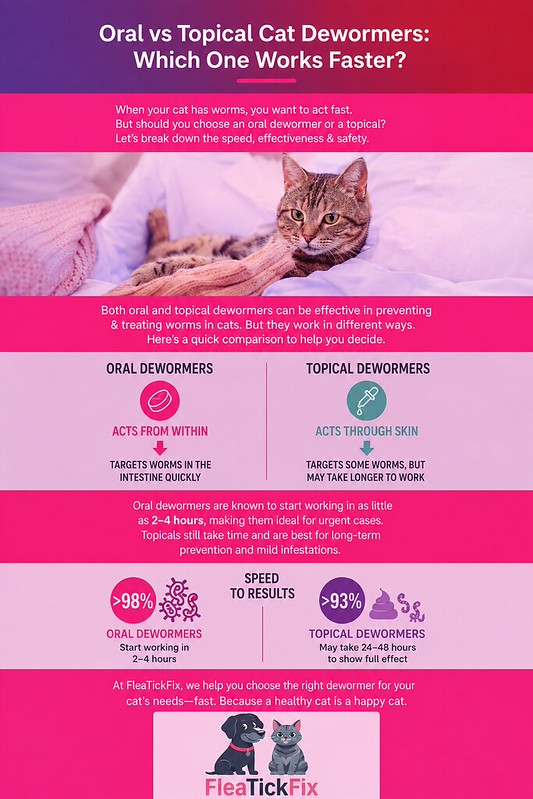
- Oral dewormers generally have a slight speed edge for intestinal worms, with some acting within hours and most showing results within 24-48 hours.
- Topical dewormers like Profender and NexGard Combo are also fast – typically kicking in within 24 hours for tapeworms and within 48 hours for other worm types – but are chosen more for convenience than raw speed.
- Full worm elimination is not instant; it can take anywhere from a few days to several weeks depending on the parasite and infestation severity.
- Identifying the worm type before choosing a product matters just as much as speed – not all dewormers cover all worms.
- Keep reading to learn exactly which product types work best in which situations, and why the fastest option is not always the right one.
When a cat has worms, the instinct is to act fast – and that raises a very reasonable question: does the form of the dewormer change how quickly it works? The short answer is yes, slightly. But the full picture is more nuanced than a simple oral-vs-topical race.


Oral Dewormers Have a Slight Speed Edge
For intestinal worms specifically, oral dewormers tend to work faster than topical options. Once swallowed, they move directly through the digestive system, which is exactly where the worms live. This gives them a more direct path to the problem. Most oral dewormers begin acting within the first 24 hours, and some start working in as little as 2 hours. Visible improvement in a cat’s condition – reduced symptoms, more energy, better appetite – is often noticeable within 2 to 3 days.
Topical dewormers are absorbed through the skin and distributed systemically, which means they take a bit longer to fully spread through the body. They are still fast and highly effective, but veterinary sources consistently indicate they are chosen more for ease of administration than for being quicker. For cat owners trying to decide, FleaTickFix breaks down these comparisons in practical, cat-owner-friendly terms.
How Quickly Oral Dewormers Start Working
Speed varies depending on the active ingredient in the oral product, so knowing what is in the dewormer being used makes a real difference.
Pyrantel: Onset Within Hours
Pyrantel pamoate is one of the fastest-acting oral dewormers available. According to veterinary journal findings, it can begin working within 2 hours of administration, with its primary action wrapping up around the 24-hour mark. It works by paralyzing roundworms and hookworms, which are then passed out of the body naturally. It is widely available over the counter and commonly used in kittens and adult cats alike.
Praziquantel Oral: Variable Onset Within 24-48 Hours
For tapeworms, praziquantel is the standard treatment. Oral formulations containing praziquantel – such as Drontal for Cats and Bayer Tapeworm Dewormer for Cats – are effective against tapeworms, though the precise onset for these specific products can vary. Many dewormers begin acting within 24 hours, but timing depends on the individual product and infestation. Drontal stands out as a broad-spectrum option because it covers roundworms, hookworms, and tapeworms in a single tablet. A single administration can eliminate tapeworms effectively, though full clearance may take up to 3 weeks as worm material is broken down and expelled.
Topical Dewormers: Also Fast, Different Strengths
Topical dewormers are absorbed through the skin at the application site – typically the back of the neck – and then distributed through the body systemically. This route avoids the digestive tract entirely, which is a significant advantage for cats prone to vomiting up pills or for owners who simply cannot get a tablet into a resistant cat.
Profender and NexGard Combo: Fast Onset With Broad Coverage
Profender (containing emodepside and praziquantel) covers roundworms, hookworms, and tapeworms in a single spot-on dose. It generally begins acting within 24 hours for tapeworm infections, while for roundworms and other intestinal worms, it typically takes effect within 48 hours of application. NexGard Combo, a newer formulation containing esafoxolaner, eprinomectin, and praziquantel, has demonstrated high-level efficacy against both endoparasites and ectoparasites in scientific studies – making it a strong choice when flea, tick, and worm coverage are all needed at once.
Chosen for Convenience, Not Speed Alone
Neither Profender nor NexGard Combo is meaningfully slower than oral options – but veterinary sources are consistent on one point: topicals are generally selected for convenience, not because they outpace oral dewormers on speed. They eliminate the pill-administration challenge, reduce the risk of a cat vomiting out the dose, and offer broad multi-parasite coverage in one application. Those are real advantages, just not speed-based ones.
One practical limitation worth noting: many spot-on treatments do not cover tapeworms, which may require adding a separate oral praziquantel product. Always check the label coverage before assuming a topical handles every worm type.
Full Elimination Is a Weeks-Long Process
Regardless of which format is used, deworming is rarely a one-and-done, same-day event. Initial onset might happen within hours, but complete elimination of worms from the body can take anywhere from 3 to 5 days for lighter infestations, or up to 2 to 4 weeks in more severe cases.
Why Multiple Doses Are Often Needed
Many deworming medications kill adult worms but do not always eliminate larvae at the same time. For severe infestations or certain worm species, a second dose is often recommended 2 to 3 weeks after the first – timed to target larvae that survived or hatched after the initial treatment. Reinfection is also possible if the cat’s environment is not addressed alongside treatment, especially in households with multiple cats or outdoor access.
When to Choose Each Type
Speed is close enough between the two formats that the more useful question is: which one fits this cat and this situation?
Oral: Precision for Known Infections
Oral dewormers make the most sense when:
- The cat tolerates pills or flavored chews without much resistance.
- The worm type has been identified through a fecal test.
- A specific, targeted treatment is needed – for example, praziquantel for confirmed tapeworms only.
- The vet has recommended a precise dosing schedule.
Products like Drontal are strong broad-spectrum oral options for cats that cooperate with oral dosing, covering the three most common intestinal worms in a single tablet.
Topical: Best for Pill-Resistant Cats
Topical dewormers are the practical winner when:
- The cat is difficult or impossible to pill.
- Combined parasite coverage – worms and external parasites – is preferred in a single application.
- Reducing the chance of a missed or vomited dose is a priority.
Profender remains the go-to topical for intestinal worm coverage without a pill. For cats needing both internal and external parasite control, NexGard Combo expands that coverage significantly in one spot-on treatment.
Know Your Cat’s Worms First
The biggest mistake cat owners make when deworming is choosing a product before knowing which worm is actually present. Pyrantel covers roundworms and hookworms but not tapeworms. Praziquantel is the standard treatment for tapeworms; as a single agent, it does not typically cover roundworms, though it is often included in combination products for broader parasite control. A product that misses the target worm is not slower – it is simply ineffective for that infection.
Common signs that point to specific worms include a pot-bellied look and spaghetti-like worms in vomit or stool (roundworms), rice-like segments near the tail or in the litter box (tapeworms), and pale gums or black and bloody stool (hookworms, which can cause anemia and need prompt treatment). When in doubt, a fecal test from a vet confirms the parasite and takes the guesswork out of product selection entirely.
Speed Is Similar; the Right Fit Matters More
Oral dewormers do have a genuine – if modest – speed advantage for intestinal worms, with some starting in as little as 2 hours and most acting within 24 to 48 hours. Topical options like Profender follow closely, beginning within 24 hours for tapeworms and within 48 hours for other worm types, while also bringing real advantages in ease of use and multi-parasite coverage. Neither type is dramatically faster than the other, and both require realistic expectations: initial action is fast, but full clearance takes days to weeks, and repeat dosing is often part of the plan.
The right dewormer is the one matched to the right worm, the right cat, and the right administration method. That combination matters far more than a few hours’ difference in onset time.
For more practical guidance on protecting cats from parasites, FleaTickFix covers cat and dog parasite treatments to help owners make confident, informed decisions.


 Verified by AmpiFire
