

Key Takeaways
- No single OTC dewormer works on every worm – the active ingredient must match the specific parasite your cat has.
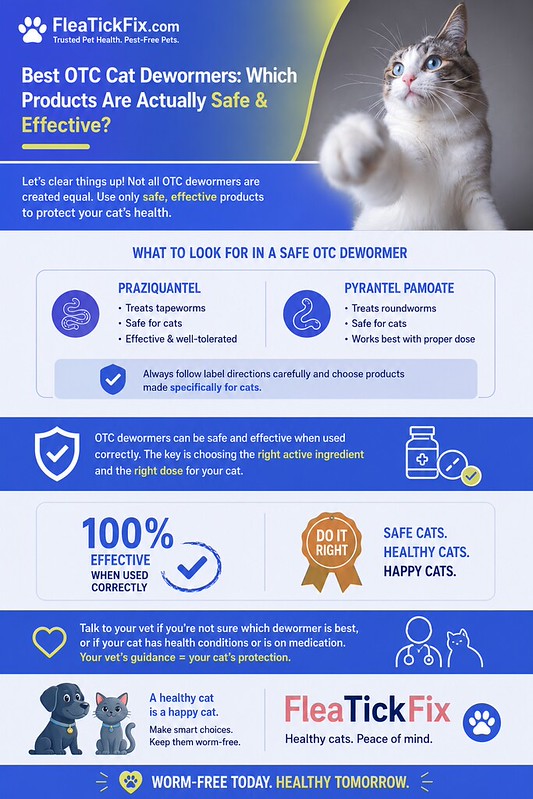
- Praziquantel targets tapeworms; pyrantel pamoate targets roundworms and hookworms; combination products cover all three.
- Weight-based dosing and cat-specific formulations are non-negotiable for safety – never use a dog dewormer on a cat.
- Kittens, pregnant cats, and cats with severe symptoms need a vet visit, not an OTC product.
- Keep reading to learn which parasites OTC products simply cannot touch – and what to do about them.
A cat scratching obsessively near its tail, tiny white specks in the bedding, or a sudden bout of vomiting – these are the kinds of signs that send cat owners straight to the pet store looking for answers. The good news: effective, non-prescription dewormers do exist. The catch? Picking the wrong one is almost the same as picking none at all. Matching the active ingredient to the specific worm type is what separates a treatment that works from one that does nothing. FleaTickFix breaks down exactly how to do that.


The Right Active Ingredient Changes Everything
Think of cat dewormers less like a general antibiotic and more like a targeted key for a specific lock. Praziquantel does nothing for roundworms. Pyrantel pamoate won’t touch tapeworms. Using the wrong product doesn’t just waste money – it leaves the infection completely untreated while giving false confidence that something is being done.
The foundation of any smart OTC deworming decision is identifying which worm is involved first. That starts with reading the signs your cat is showing.
Spot the Worm First
Cats carry their symptoms differently depending on which parasite has taken up residence. Learning to read those clues is step one.
Tapeworm Signs: Rice-Grain Segments
Tapeworms are usually the easiest to identify without a vet. The telltale sign is small, flat, white segments – often described as looking like grains of rice – found near the cat’s rear end, in the bedding, or occasionally in the stool. Fresh segments may even move slightly. These segments are shed pieces of the tapeworm itself, and spotting them is a strong visual confirmation that praziquantel is the right call.
Tapeworms aren’t transmitted cat-to-cat. Dipylidium caninum, the most common feline tapeworm, spreads when a cat swallows an infected flea during grooming. That flea connection matters a great deal for preventing reinfection.
Roundworm Signs: Spaghetti in Stool or Vomit
Roundworms look exactly as the name implies – long, round, and pale, resembling strands of spaghetti. They may appear in vomit or stool, and in kittens they can cause a visibly pot-bellied appearance alongside poor growth and lethargy. Adult cats often carry low-level roundworm infections with few obvious signs, but a visible worm in vomit is a hard-to-miss indicator.
Hookworm Signs: Invisible but Dangerous
Hookworms are the parasite that often goes unnoticed until the damage is done. They’re microscopic, so there’s nothing visible in the stool. Instead, watch for pale gums, unusual weakness, dark or tarry stools, and unexplained weight loss – all signs of internal blood loss. Hookworms attach to the intestinal wall and feed on blood, which makes heavy infections genuinely dangerous, particularly in kittens.
Praziquantel for Tapeworms
Praziquantel is the gold standard for treating feline tapeworms without a prescription. Specifically formulated to target cestodes – the class of parasites that includes tapeworms – it does so with a high degree of effectiveness.
Which Tapeworm Species It Targets
FDA-reviewed labeling for praziquantel products confirms efficacy against Dipylidium caninum (the flea tapeworm) and Taenia taeniaeformis (the rodent tapeworm). These two species account for the overwhelming majority of feline tapeworm cases. Bayer/Elanco’s Tapeworm Dewormer for Cats is one widely available OTC praziquantel option. The label excludes kittens under six weeks of age – a restriction worth checking before purchase.
Why One Dose Often Clears the Infection
Praziquantel works by disrupting the tapeworm’s outer skin and musculature, causing it to disintegrate and be absorbed or expelled by the cat’s digestive system. This mechanism is fast and thorough enough that a single dose typically clears an active infection. Re-treatment may be needed if the cat is re-exposed – particularly when an ongoing flea problem isn’t addressed at the same time. Treating the worms without treating the fleas addresses only half the problem.
Pyrantel Pamoate for Roundworms and Hookworms
For roundworms and hookworms, pyrantel pamoate is the go-to OTC active ingredient. Several feline-labeled formulations are available, including Sentry WormX Plus and Pro-Sense Liquid Dewormer.
How It Paralyzes and Expels Worms
Pyrantel pamoate works as a depolarizing neuromuscular-blocking agent – in plain terms, it paralyzes worms by disrupting the nerve signals that control their muscles. Once paralyzed, the worms can no longer grip the intestinal wall and are naturally expelled through the digestive tract. It has a well-established safety margin in cats when used at label-specified doses. One nuance worth noting: standalone pyrantel pamoate products for cats may sometimes be applied outside the strict FDA-approved indication, which is a reason to stick to established brands with transparent labeling rather than generic or unverified products.
OTC Combination Products: What They Cover and Where They Stop
When the worm situation isn’t completely clear – or when multiple species are suspected – combination products offer broader coverage without requiring multiple separate treatments.
Praziquantel Plus Pyrantel Pamoate: The OTC Sweet Spot
Products that pair both active ingredients, such as Drontal Tablets for Cats, represent the broadest OTC coverage available without a prescription. This combination targets tapeworms (Dipylidium caninum, Taenia taeniaeformis), large roundworms, and hookworms in a single treatment. For a cat owner who sees rice-grain segments and suspects roundworm exposure from outdoor activity, this is a logical first choice. FDA approval supports the safety and efficacy of this combination for the listed parasite species when used according to label directions.
Parasites That Still Require a Prescription
OTC combination products are genuinely useful, but they have hard limits. Heartworms require diagnosis and prescription treatment – no OTC dewormer addresses them. Lungworms fall outside standard OTC coverage as well. Microscopic single-celled parasites like Giardia and Coccidia cause serious gastrointestinal illness but are completely unaffected by praziquantel or pyrantel pamoate. Fenbendazole – a broad-spectrum dewormer – can address Giardia and some tapeworm species that OTC products miss, but it requires veterinary guidance for cats given its extra-label application. If symptoms include watery, foul-smelling, or mucousy diarrhea without visible worms, a fecal exam to rule out these organisms is the right next step.
Using OTC Dewormers Safely
Choosing the right active ingredient is only half the equation. How the product is administered matters just as much.
Weight-Based Dosing Is Non-Negotiable
Dewormers are dosed by body weight – not estimated weight, actual weight. Weigh the cat on a digital scale before purchasing or administering any product. Under-dosing leaves worms alive and reproducing. Over-dosing risks vomiting, tremors, or lethargy. This is especially true with liquid formulations, where small measurement errors are easy to make. Follow the product’s specific weight bands exactly, and don’t round up.
Cat-Specific Formulations Only: A Potentially Fatal Distinction
This point cannot be overstated: never give a cat a dewormer formulated for dogs. Canine products can contain active ingredients or inactive additives that are toxic – sometimes fatally so – to cats. Permethrin, commonly found in dog flea and tick products, is acutely toxic to cats. The same logic applies to human dewormers or any product not explicitly labeled for feline use. Buy from a reputable retailer, check the label for a cat-specific indication, and avoid natural, herbal, or homeopathic alternatives – they lack evidence for parasite clearance and some ingredients, like garlic and certain essential oils, are directly toxic to cats.
When a Vet Visit Beats Any OTC Product
OTC dewormers are a practical solution for mild infections in healthy adult cats. They are not appropriate for every situation.
Kittens, Pregnant Cats, and Sick Cats
Kittens are particularly vulnerable – they carry heavier parasite burdens relative to body size, dehydrate faster, and are more susceptible to anemia from hookworm blood loss. Most praziquantel labels exclude kittens under six weeks. Pregnant and nursing cats require vet-guided treatment to avoid risks to developing or nursing kittens. Any cat that is elderly, chronically ill, underweight, or on other medications also warrants veterinary oversight rather than an OTC approach.
Severe symptoms – repeated vomiting, rapid weight loss, bloody or black stool, pale gums, collapse, or signs that persist after treatment – are a signal to stop self-treating and seek care promptly.
Parasites OTC Products Cannot Touch
Beyond the prescription-only parasites already mentioned, symptoms alone can’t reliably identify a parasite. Several non-parasitic gastrointestinal conditions look identical to worm infections. A fecal flotation exam from a vet can identify a broad range of intestinal parasites and rule out non-parasitic disease – the only practical way to confirm what’s actually being treated. When the parasite is uncertain, guessing at an OTC product is a shot in the dark.
Match the Ingredient, Treat the Worm, Protect Your Cat
The OTC dewormer aisle isn’t confusing once the logic clicks: praziquantel for tapeworms, pyrantel pamoate for roundworms and hookworms, and a combination product when coverage needs to be broader. Weight-based dosing, cat-specific formulations, and honest assessment of a cat’s overall health are what separate a treatment that resolves the problem from one that simply delays a vet visit. For cats showing severe symptoms, for kittens, and for parasites outside the OTC window, professional diagnosis is the only appropriate path forward.
For more guidance on protecting cats from parasites – including fleas, ticks, and the worms they carry – visit FleaTickFix, a resource dedicated to helping pet owners handle parasite prevention and treatment with confidence.


 Verified by AmpiFire
